
Hidden in the rocky cliffside of Pembrokeshire is a tiny stone chapel with roots tracing back to the 5th and 6th centuries. It’s called St Govan’s Chapel and I can highly recommend checking it out if you’re in the area.
In this article, I’ll explain a little about the landmark's history as well as tips to help you plan your visit.
What is St Govan's Chapel?
St Govan’s Chapel is a medieval stone church built into the cliffside along the Pembrokeshire coastline. Its roots date back to the 5th and 6th centuries.
According to legend, St Govan was travelling the coast of Pembrokeshire when he was chased by pirates. A cleft opened up in the rocks allowing him to hide from his enemies. It closed behind him so that the pirates could not find him.

Grateful for the experience, he proceeded to build a chapel on that site. The hiding place can still be seen inside the chapel through a doorway next to where the altar would have been (see below image)

He continued to live here as a hermit, catching fresh fish in the ocean and drinking water from the spring in front of the chapel.
This spring is known as St Govan’s Well. Although the spring has long run dry, it is said that this well was a pilgrimage site for those with health conditions.
An old journal states that “crippled patients bathe their limbs, many of whom come from the remotest parts of the principality to seek relief here and leave their crutches behind"

St Govan's Well
It is said that St Govan also had a bell which he kept to warn others if the pirates returned. When the pirates found out about this, they stole the bell in spite. But justice quickly prevailed as their ship sank in a storm shortly after and angels are said to have returned the bell to St Govan
Visiting St Govan’s Chapel
To visit St Govan's Chapel by car, head to the village of Bosherston and follow the signs for St Govan’s. After about 4 minutes, you’ll reach St Govan’s car park which is free of charge. From here, the chapel is just two minutes of walking.

If visiting St Govan’s Chapel by public transport, there is a bus stop right next to the car park. It is served by the Pembrokeshire Coastal Cruiser services 387 and 388, which go all the way to Pembroke.
Note that the buses are less frequent during the off-season (October to May). Check the latest timetables here.
How Much Does it Cost?
There is no entrance fee to visit St Govan’s Chapel and the car park is free of charge too.
Opening Times
St Govan’s Chapel is open 24 hours per day, 7 days per week.
Facilities at St Govan’s Chapel
There are no facilities at St Govan’s Chapel. There is occasionally an ice cream van serving drinks and snacks in the car park during peak times (cash only). There are no toilets, the closest toilets are in Bosherton.
How Many Steps Are There at St Govan's Chapel?
It is said that the steps down to the chapel are enchanted and impossible to count accurately with some estimates suggesting as few as 52. However, there are in fact 74 steps down to St Govan’s Chapel.
These are steep stone steps so it’s not suitable for prams, wheelchairs, or those with accessibility problems.

Where to Park for St Govan’s Chapel
There is a free car park just 2 minutes from St Govan’s Chapel, it is called St Govan’s car park. Here are the details for it:
- Coordiantes: 51.599514, -4.937350
- What3Words: destroyer.bandstand.zipped
- Google Maps Pin: https://goo.gl/maps/iCTNNdTBc9iTKss36

St Govan’s Head Walk
There is an easy walk from St Govan’s Chapel to the old coastguard station at St Govan’s head. The walk is 1.1 mile (1.8km) there and back so should take around 25 minutes in total.
The walk is along a surfaced path with some small inclines. Find out more information along with a downloadable PDF here.
Other Places to Visit Nearby
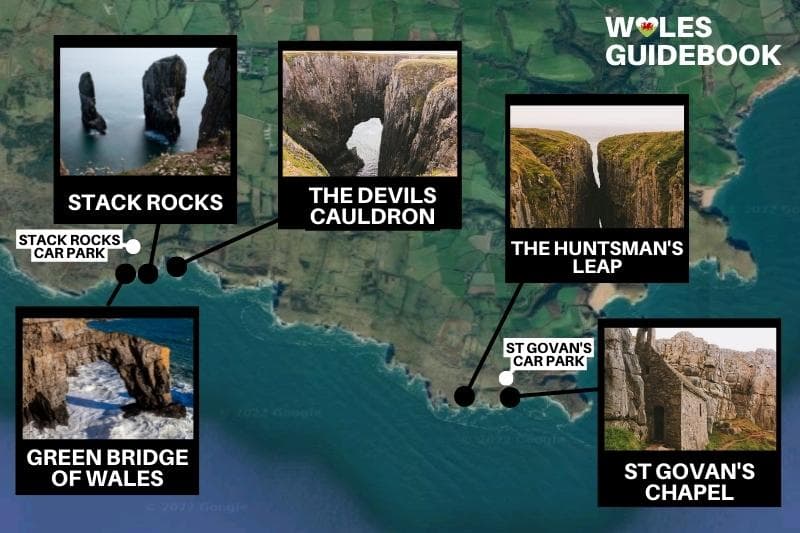
Visiting this part of the Pembrokeshire Coastal Path is easily one of the best things to do in West Wales. St Govan’s Chapel isn’t the only awesome landmark worth checking out, here are a few others nearby:
- The Huntsman’s Leap – Around 6-7 minutes walking from the chapel is the Huntsman’s Leap, a deep, narrow fissure in the Earth with an interesting folktale related to its name (read it here).
ㅤ - The Green Bridge of Wales – A little further along the coastal path is this natural arch formed by coastal erosion.
ㅤ - Stack Rocks – Next to the Green Bridge you’ll find Stack Rocks, these limestone pillars would have also been arches at some point before their collapse.
ㅤ - The Devil’s Cauldron – This is a large shaft in the Earth which would have formed when underground caves collapsed.
Related Questions
Who Was St Govan?
There is much debate over who St Govan actually was. Although the current name of the chapel is St Govan’s, it has also been referred to as St Gouen, Gowen, Goven, Gofan and Gobin over time.
The most popular theory is that St Govan was an Irish monk from Wexford, originally known as St Gobham. It is thought that he might have travelled to Wales to visit St David
An alternative theory is that St Govan is Gawain, one of King Arthur's Knights of the Round Table.
How Old is the Chapel?
Although the original stories of St Govan date back to the 5th or 6th centuries, the current stone chapel was likely built much later, sometime between the 13th and 14th centuries.
The chapel is in great condition, although this is mostly due to renovation work that took place in the 1980s to restore the structure
Published: 27 September 2022